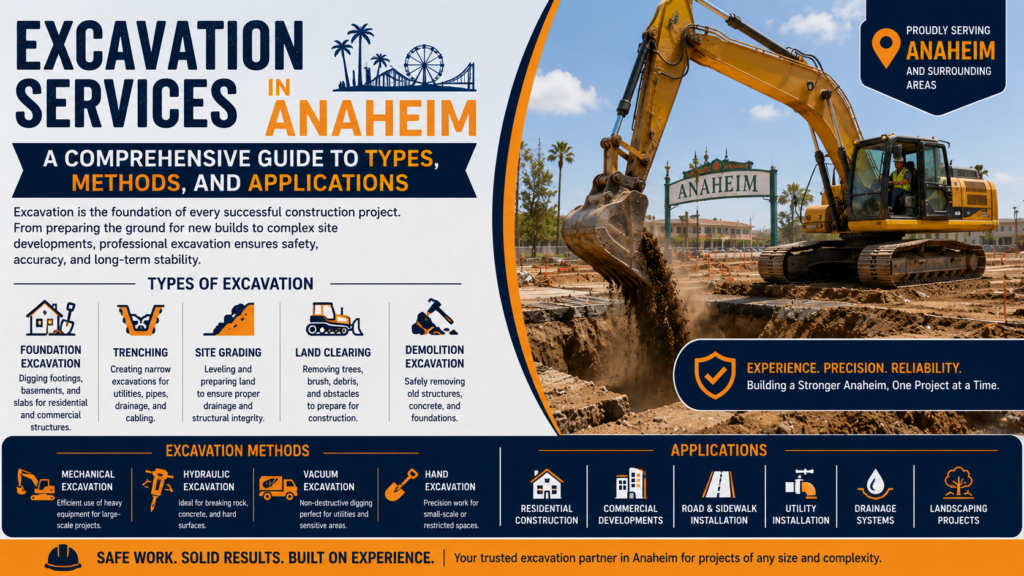
When most people think of construction in Anaheim, they picture the finished product a smooth driveway, a new building, a freshly paved parking lot. What they rarely see is the extensive groundwork that happens before any surface material is applied. Excavation services form the invisible foundation beneath every successful construction project in Anaheim. Whether it is preparing a site for a new commercial development near the Anaheim Convention Center or grading a residential lot in Anaheim Hills, professional excavation is what makes long-lasting results possible. This guide explains what Excavation Services Anaheim are, the types of excavation commonly used in Anaheim, the equipment involved, and why proper site preparation is critical to any construction outcome.
What Are Excavation Services?
Excavation refers to the process of moving, removing, or repositioning earth, rock, or other materials from a construction site in order to create space for building structures, foundations, utilities, or paved surfaces. It is among the first steps of any significant construction or paving project and directly determines the stability and longevity of whatever is built on top.
Contrary to common assumptions, excavation is not simply about digging a hole. It is a precise science that involves assessing soil composition, understanding drainage patterns, managing groundwater, and using specialized machinery to achieve specific grading outcomes. Professional excavating contractors in Anaheim work from engineering plans and site surveys to ensure that every cubic yard of earth removed or moved serves a defined purpose.
Types of Excavation Commonly Used in Anaheim
Excavation work is categorized based on the purpose of the digging, the material being removed, and the technique used. Understanding these categories helps property owners and developers communicate more effectively with their contractors.
Earth Excavation: This is the most common form, involving the removal of the upper layers of soil beneath the topsoil surface. Earth excavation is used in bridge construction, building foundations, drainage systems, and road preparation.
Trench Excavation: Trenches are excavated areas where the length significantly exceeds the depth. This type of excavation is used to bury utility lines, install sewer and water pipes, lay drainage conduits, and place irrigation systems. Trench excavation depth can range from shallow, under six meters, to deep, over six meters, depending on the infrastructure being installed.
Topsoil Removal: The uppermost layer of earth containing organic matter, roots, and biological material is stripped away before construction begins. This layer is too unstable and compressible to serve as a foundation and must be removed to reach more stable subsoil.
Rock Excavation: When bedrock or dense rock formations lie beneath a construction site, standard earthmoving equipment may be insufficient. Rock excavation involves specialized pneumatic hammers, hydraulic breakers, drilling equipment, and sometimes controlled blasting to break up and remove rock. Note that removing concrete pavement or retaining walls is generally not classified as rock excavation.
Basement Excavation: Used when construction extends below ground level, such as for underground parking garages, basement-level spaces, or below-grade utility rooms. This type is more complex due to depth and the need to manage soil stability on all sides of the excavation.
Drainage Excavation: Specifically aimed at improving or creating water management systems, drainage excavation involves reshaping the land to direct water flow away from structures and toward appropriate outlet points. This is especially important in Anaheim, where occasional heavy winter rains can overwhelm unprepared drainage systems.
Borrow Excavation: When a construction site lacks sufficient usable material for fill, compaction, or grading, material is obtained from an external source called a borrow site and brought in. This ensures the correct soil composition is used to achieve proper compaction and load-bearing capacity.
Unclassified Excavation: When a site contains a mixed or indeterminate combination of materials some soil, some rock, some debris it is classified as unclassified excavation. This requires adaptable equipment and techniques as conditions change across the site.
Equipment Used in Excavation Services
Professional excavation in Anaheim relies on a range of specialized heavy machinery:
Excavators (Backhoes): The most recognizable piece of excavation equipment, these machines use a hydraulic arm and bucket attachment to dig, scoop, and move earth. Different bucket sizes are used depending on the scale of the excavation.
Bulldozers: Used to push large quantities of soil, clear vegetation and debris, and establish rough grades across a site. Bulldozers are essential in large-scale site preparation.
Graders (Motor Graders): These machines use a long blade to establish precise, even grades across the surface of a site. They are critical in road construction and any project where specific drainage slopes must be maintained.
Dump Trucks: Haul excavated material away from the site or bring fill material in. The volume of truck trips required is one factor that influences project timelines.
Compactors and Rollers: After fill material is placed, it must be compacted to achieve the density necessary to support the structures above. Compactors use vibration, weight, or both to achieve the required compaction levels.
Skid Steer Loaders: Compact, maneuverable machines used in tight spaces where larger equipment cannot operate. Common in urban Anaheim job sites with limited access.
Why Proper Excavation Matters for Paving Projects in Anaheim
Excavation is directly connected to the success of paving projects throughout Anaheim. When it comes to asphalt or concrete driveways, parking lots, and roadways, the quality of what lies beneath the surface is just as important as the paving material itself. Poor site preparation including insufficient excavation depth, inadequate compaction, or improper drainage grading leads to premature pavement failure manifested as cracking, settling, rutting, and pothole formation.
Anaheim’s soil composition varies across the city. Areas near the Santa Ana River corridor contain clay-heavy soils that are prone to expansion and contraction with moisture changes. This means that proper subgrade preparation including adequate excavation depth to remove unstable material and replacement with compacted aggregate base is especially critical in these areas to prevent surface movement after paving.
Additionally, Anaheim’s occasional but sometimes intense winter rainfall events require paved surfaces to be graded so that water flows away from structures and toward appropriate drainage points. This grading work is part of the excavation process and must be done correctly before any surface material is applied.
Excavation for Utility Installation in Anaheim
Urban and suburban development in Anaheim requires extensive underground infrastructure water supply lines, sewer systems, electrical conduits, telecommunications cables, gas lines, and stormwater drainage. Installing or replacing any of these utilities requires precise trench excavation performed by qualified contractors who understand how to work safely around existing underground infrastructure.
Before any excavation begins in Anaheim, contractors must contact Underground Service Alert commonly known as Dig Alert to identify and mark the locations of existing underground utilities. Striking a buried utility line during excavation can cause dangerous disruptions, property damage, and serious safety hazards. Professional excavating contractors follow all required notification and safety protocols.
Safety Considerations in Excavation Work
Excavation is among the most hazardous activities in the construction industry. Trench cave-ins, equipment accidents, and unexpected utility strikes are serious risks. Professional excavating contractors in Anaheim operate in compliance with California Occupational Safety and Health Administration (Cal/OSHA) regulations, which include specific requirements for:
Soil classification and shoring or sloping of trench walls to prevent collapse. Any trench deeper than five feet in California requires cave-in protection measures.
Provision of safe means of entry and exit from excavations, including ladders or ramps.
Regular inspection of excavations by a competent person before work begins and after weather events.
Air monitoring in excavations where hazardous atmospheres such as methane or low oxygen might be present.
These safety requirements exist because the consequences of an excavation accident can be severe. Hiring a licensed, insured, and experienced excavating contractor in Anaheim ensures that all safety standards are met.
Permitting and Regulatory Requirements in Anaheim
Most excavation work in Anaheim, particularly work that affects public right-of-way, utilities, or exceeds certain depths, requires permits from the City of Anaheim’s Public Works Department. Excavation near public streets may also require traffic control measures such as lane closures, flaggers, and temporary signage.
Professional excavating contractors are familiar with Anaheim’s permitting process and typically handle the application, coordination, and compliance documentation on behalf of their clients. This knowledge of local regulatory requirements is one of the key advantages of working with an experienced local contractor rather than a less familiar firm.
Frequently Asked Questions About Excavation Services in Anaheim
What is the purpose of grading during excavation? Grading establishes the correct slopes and elevations across a site to ensure proper drainage and a stable foundation. Even minor errors in grading can lead to water pooling, erosion, and pavement failure over time.
How deep does excavation typically go for a driveway or parking lot? This varies by project, but most residential and commercial paving projects in Anaheim require excavation to a depth of at least six to twelve inches to remove unstable topsoil and provide room for a compacted aggregate base.
How long does site excavation take? A simple residential site preparation might take one to two days, while a large commercial development could require weeks of excavation work depending on site conditions and project scope.
Can excavated soil be reused? In some cases, yes. If excavated soil meets the required specifications for compaction and bearing capacity, it can be used as fill elsewhere on the site. However, organic topsoil is generally not suitable for structural fill.
What happens if rock is encountered during excavation? The contractor will assess whether the rock can be broken with hydraulic equipment or requires drilling and controlled removal. This may affect the project timeline and the methods used.
Conclusion
Excavation services in Anaheim are a foundational component of construction that often receive less attention than the visible surfaces above them yet they determine the long-term success of every paving and building project. From trench excavation for underground utilities to mass earth removal for building foundations and precise grading for drainage management, professional excavation work requires specialized knowledge, proper equipment, and rigorous safety practices.